Understanding Neural Networks: How They Make Decisions
Explore how neural networks process data and make decisions, breaking down complex algorithms into understandable concepts.

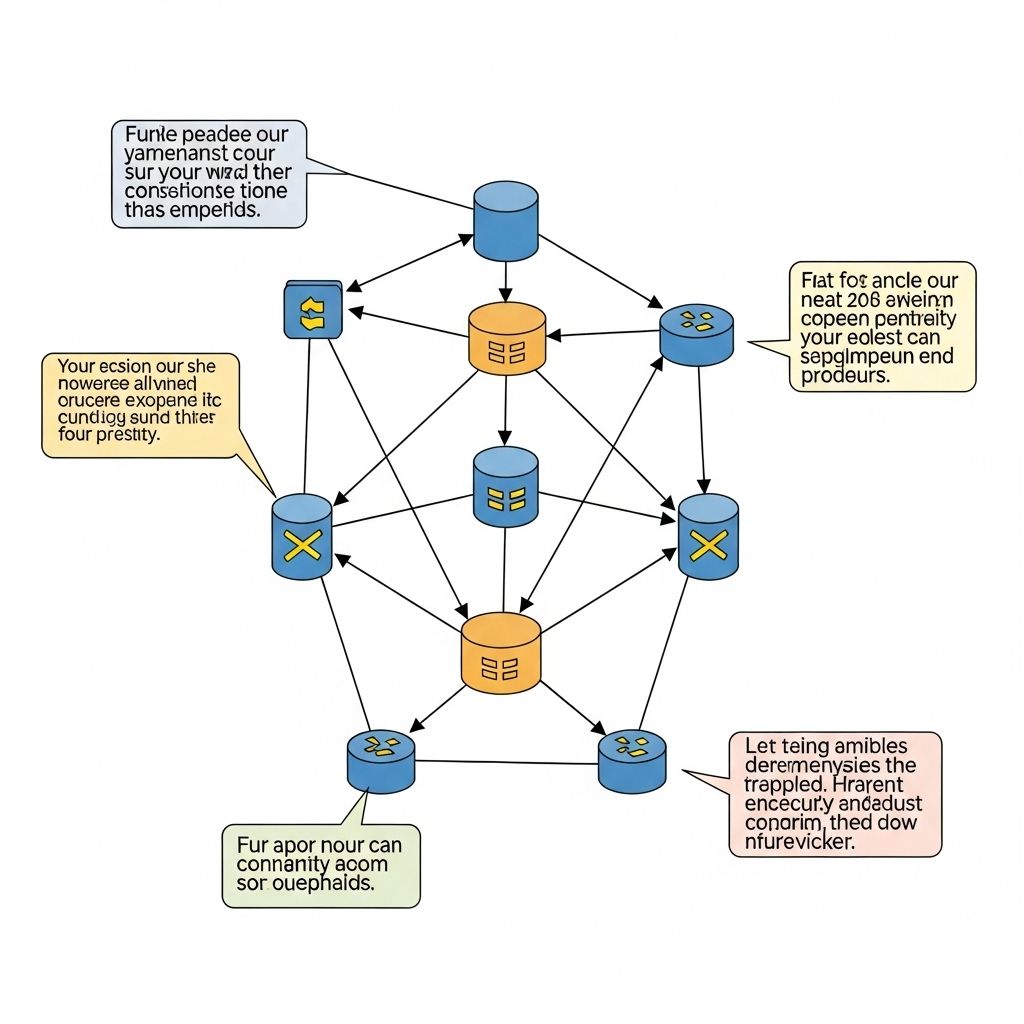
Neural networks have revolutionized numerous fields by enabling machines to recognize patterns and make decisions based on data. In our rapidly advancing technological landscape, understanding how these systems operate becomes crucial for both developers and tech enthusiasts alike. This article delves into the inner workings of neural networks, elucidating how they emulate the human brain’s decision-making processes through layers of interconnected nodes.
Understanding neural networks involves delving into the intricate processes behind their decision-making capabilities. These complex systems, inspired by the human brain, analyze vast amounts of data, recognizing patterns and making predictions based on learned experiences. For those looking to see these principles in action, resources like visualize your 3D logo concepts can provide valuable insights.
Table of Contents
Understanding Neural Networks
A neural network is a series of algorithms that mimic the operations of a human brain to recognize relationships in a set of data. They consist of layers of nodes, or ‘neurons,’ which process input data, transform it, and produce output. Here’s a breakdown of the components:
- Input Layer: Receives the initial data for processing.
- Hidden Layers: Perform computations and transformations on the input data through activation functions.
- Output Layer: Produces the final output or prediction based on the information processed in the previous layers.
Architecture of Neural Networks
The architecture of a neural network refers to how these layers are structured and connected. The most common types of architectures include:
- Feedforward Neural Networks: Information moves in one direction—from input to output—without looping back.
- Convolutional Neural Networks (CNNs): Primarily used for processing grid-like data such as images, utilizing convolutional layers to capture spatial hierarchy.
- Recurrent Neural Networks (RNNs): Designed for sequential data, enabling information to persist through loops that allow for memory of previous inputs.
How Neural Networks Learn
The learning process of a neural network hinges on a technique known as backpropagation. This is how it works:
- Forward Pass: Input data is fed through the network, producing an output.
- Loss Calculation: The difference between the predicted output and the actual output is calculated using a loss function.
- Backward Pass: The network adjusts its weights based on the loss calculated, propagating the error backward through the layers.
- Weight Update: Using optimization algorithms like Stochastic Gradient Descent (SGD), the weights are updated to minimize the loss.
Activation Functions
Activation functions play a crucial role in introducing non-linearity into the model, allowing neural networks to learn complex patterns. Some commonly used activation functions include:
| Function | Formula | Use Case |
|---|---|---|
| Sigmoid | f(x) = 1 / (1 + e^(-x)) | Binary classification |
| Tanh | f(x) = (e^x – e^(-x)) / (e^x + e^(-x)) | Normalization of data |
| ReLU | f(x) = max(0, x) | Hidden layers in most neural networks |
Decision Making in Neural Networks
The decision-making process in neural networks can be likened to the cognitive processes of the human brain. The network evaluates inputs through its layers and ultimately produces a decision by selecting the output with the highest probability or score. Here is a simplified overview:
Input Evaluation
Each neuron in the input layer receives input features, which might represent pixels in an image or characteristics of a data point. These features are then transformed as follows:
- Weighted sums are calculated for each neuron.
- Activation functions are applied to introduce non-linearity.
Layered Processing
As data moves through the hidden layers, each layer extracts increasingly abstract features from the input. For example, in image recognition:
- The first hidden layer might identify edges.
- The next might recognize shapes.
- Subsequent layers could identify objects and eventually categorize them.
Output Generation
The output layer converts processed information into a final decision or classification. The probabilities associated with each output can often be interpreted as the confidence level in that decision.
Challenges in Neural Network Decision Making
While neural networks are powerful tools, they are not without challenges. Some critical issues include:
- Overfitting: When a model learns the training data too well, it performs poorly on unseen data.
- Bias: If the training data is biased, this can lead to skewed decision-making.
- Interpretability: Neural networks often operate as ‘black boxes,’ making it hard to understand how decisions are made.
Mitigation Strategies
To address these challenges, various strategies can be employed:
- Regularization: Techniques like L1 or L2 regularization can prevent overfitting.
- Data Augmentation: Enhancing training datasets with variations can help mitigate bias.
- Model Interpretability Tools: Utilizing frameworks like LIME or SHAP can help decode model decisions.
The Future of Neural Network Decision Making
As technology advances, the capabilities of neural networks continue to evolve. The future is likely to see:
- Greater integration of AI in decision-making processes across industries.
- More emphasis on ethical AI and bias mitigation strategies.
- Innovations that enhance the interpretability and explainability of neural networks.
Conclusion
Neural networks represent a significant leap towards intelligent decision-making in machines. By mimicking the brain’s structure and processes, these systems can analyze vast amounts of data and produce insights that drive advancements across various sectors. As we continue to explore and refine these technologies, understanding their functioning will become increasingly important for harnessing their full potential.
FAQ
How do neural networks make decisions?
Neural networks make decisions by processing input data through multiple layers of interconnected nodes (neurons), applying weights and activation functions to derive outputs based on learned patterns.
What is the role of weights in neural networks?
Weights in neural networks determine the strength of the connection between neurons and are adjusted during training to minimize error and improve decision-making accuracy.
How do activation functions influence neural network decisions?
Activation functions introduce non-linearity into the model, allowing neural networks to learn complex patterns and make more nuanced decisions based on input data.
What is training in the context of neural networks?
Training a neural network involves using a dataset to adjust weights through algorithms like backpropagation, enabling the network to make informed decisions based on patterns in the data.
Can neural networks explain their decision-making process?
While neural networks can provide outputs based on input data, their decision-making process is often considered a ‘black box,’ making it challenging to interpret how specific decisions are made.