Mastering the Periodic Table: Tips and Tricks
Unlock the secrets of the periodic table with essential tips, tricks, and strategies for mastering its elements and understanding their significance.

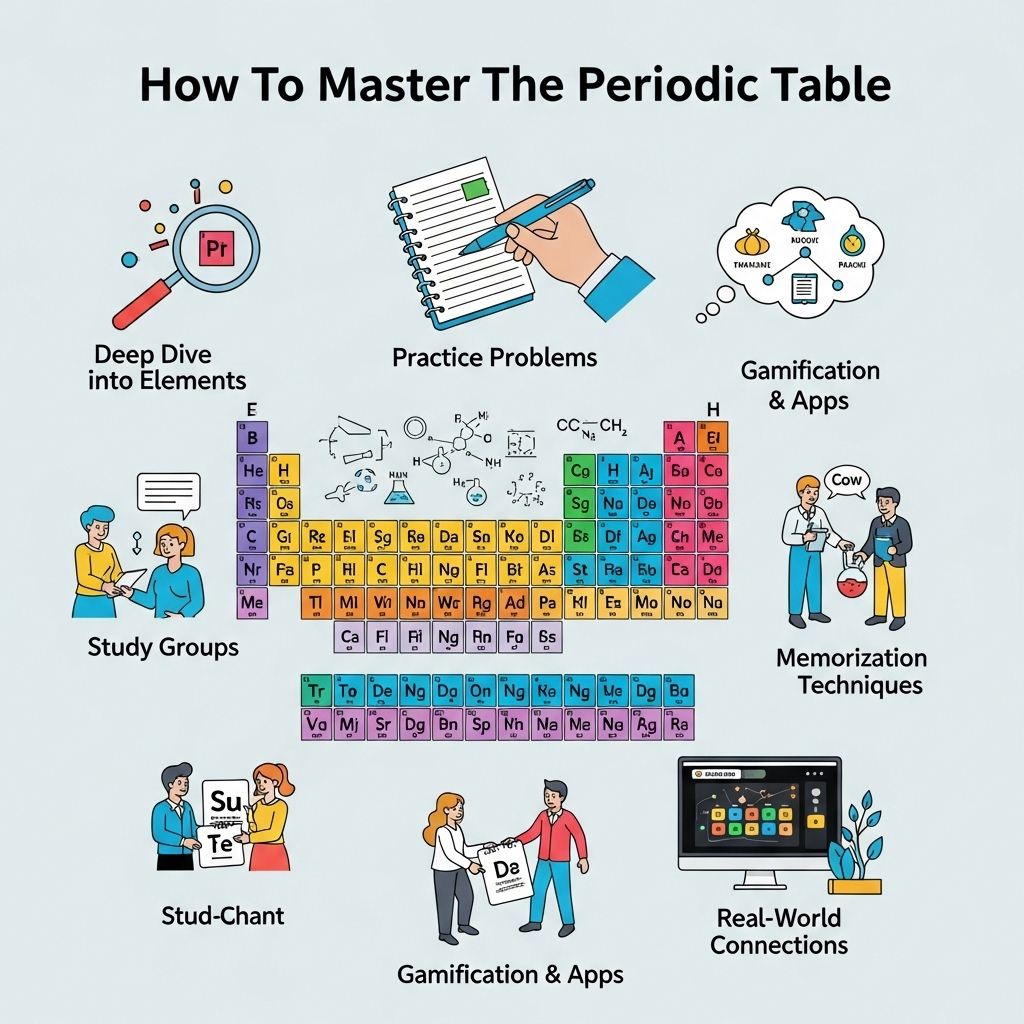
The Periodic Table of Elements is a fascinating and essential tool in chemistry that organizes all known elements based on their atomic number, electron configurations, and recurring chemical properties. Mastering the Periodic Table can significantly enhance your understanding of chemistry, enabling you to predict the behavior of elements and their compounds. In this article, we will explore effective strategies to help you become proficient in interpreting the Periodic Table.
Mastering the periodic table is essential for anyone interested in chemistry, and it can be made easier with a few helpful tips and tricks. From mnemonic devices to visual aids, these strategies will help you memorize element names and their properties effectively. For instance, exploring elements in innovative formats, such as diagrams or discover unique 3D logo examples, can enhance understanding and retention.
Table of Contents
Understanding the Structure of the Periodic Table
The Periodic Table is organized into rows called periods and columns known as groups. Each element is represented by a chemical symbol, atomic number, and atomic mass. Here’s a basic breakdown:
Periods and Groups
- Periods: Horizontal rows that indicate increasing atomic number. For example, elements in period 1 have atomic numbers from 1 to 2.
- Groups: Vertical columns that group elements with similar chemical properties. For instance, Group 1 elements are alkali metals that are highly reactive.
Key Features of the Table
| Element | Symbol | Atomic Number | Atomic Mass |
|---|---|---|---|
| Hydrogen | H | 1 | 1.008 |
| Helium | He | 2 | 4.0026 |
| Lithium | Li | 3 | 6.94 |
Strategies for Mastering the Periodic Table
To become adept at utilizing the Periodic Table, consider these effective strategies:
1. Memorization Techniques
While understanding the table is crucial, memorization of key elements can help speed up your learning:
- Mnemonic Devices: Create mnemonics to remember groups of elements. For example, for the first ten elements: Happy Henry Likes Beer But Could Not Obtain Food.
- Flashcards: Use flashcards to quiz yourself on the symbols and properties of elements.
2. Visual Learning
Visual learners can benefit from color-coded periodic tables:
- Color Coding: Different colors can represent various element categories, such as metals, nonmetals, and metalloids.
- Interactive Apps: Utilize educational apps and websites that offer interactive periodic tables.
3. Practical Applications
Understanding the practical applications of elements can reinforce your learning:
- Real-life Examples: Learn how elements are used in daily life, such as sodium in table salt or carbon in organic compounds.
- Laboratory Experiments: Conduct simple experiments that highlight the properties of specific elements.
Exploring Element Properties
Each element on the Periodic Table has unique properties that determine how they interact with one another. Here are some properties to investigate:
Atomic Structure
Understanding the atomic structure is fundamental:
- The nucleus contains protons and neutrons.
- Electrons orbit the nucleus in energy levels.
Chemical Properties
- Reactivity: Elements vary in reactivity, with alkali metals being highly reactive.
- Electronegativity: This property influences how elements bond with each other.
- Ionization Energy: The energy required to remove an electron from an atom.
Utilizing Periodic Trends
Periodic trends, such as electronegativity and atomic radius, are important concepts to grasp:
Key Trends
- Atomic Radius: Generally decreases across a period and increases down a group.
- Electronegativity: Increases across a period and decreases down a group.
- Ionization Energy: Increases across a period and decreases down a group.
Advanced Techniques
Once you have a solid understanding of the basics, consider delving deeper into advanced topics:
1. Chemical Bonding
Explore how elements bond based on their position in the Periodic Table:
- Ionic Bonds: Formed between metals and nonmetals.
- Covalent Bonds: Formed between nonmetals.
2. Understanding Isotopes
Isotopes are variants of elements with different numbers of neutrons:
- Learn how isotopes affect the element’s mass and stability.
- Understand the applications of isotopes in medicine and research.
Conclusion
Mastering the Periodic Table is a rewarding journey that enhances your comprehension of chemistry and its applications. By using effective memorization techniques, visual aids, and practical applications, you can develop a robust understanding of elements and their properties. Remember that the Periodic Table is not just a chart; it’s a gateway to exploring the building blocks of matter. Embrace your curiosity and continue to discover the wonders of the chemical world!
FAQ
What is the Periodic Table and why is it important?
The Periodic Table is a tabular arrangement of chemical elements organized by their atomic number, electron configurations, and recurring chemical properties. It is important because it provides a comprehensive overview of elements and helps predict their behavior in chemical reactions.
What are some effective strategies to master the Periodic Table?
Effective strategies include using mnemonic devices to remember element positions, practicing with flashcards, engaging in interactive periodic table games, and regularly revisiting and quizzing yourself on the elements and their properties.
How can I use the Periodic Table to predict chemical reactions?
You can use the Periodic Table to predict chemical reactions by understanding the trends in reactivity, electronegativity, and ionization energy, which help you determine how different elements will interact with each other.
Are there any online resources or apps to help learn the Periodic Table?
Yes, there are numerous online resources and apps available, such as interactive periodic tables, educational websites, and mobile applications that offer quizzes, games, and visual guides to help you learn the elements effectively.
What are the key trends in the Periodic Table that I should know?
Key trends in the Periodic Table include atomic radius, ionization energy, electronegativity, and electron affinity, which change predictably across periods and groups, aiding in the understanding of element behavior.
How can I make learning the Periodic Table more engaging?
To make learning more engaging, consider incorporating visual aids, group study sessions, hands-on experiments with elements, and using creative projects like building models or creating videos to explain concepts.