10 Essential Composition Rules for Every Photographer
Discover the 10 essential composition rules that every photographer must know to elevate their photography skills and capture stunning images.
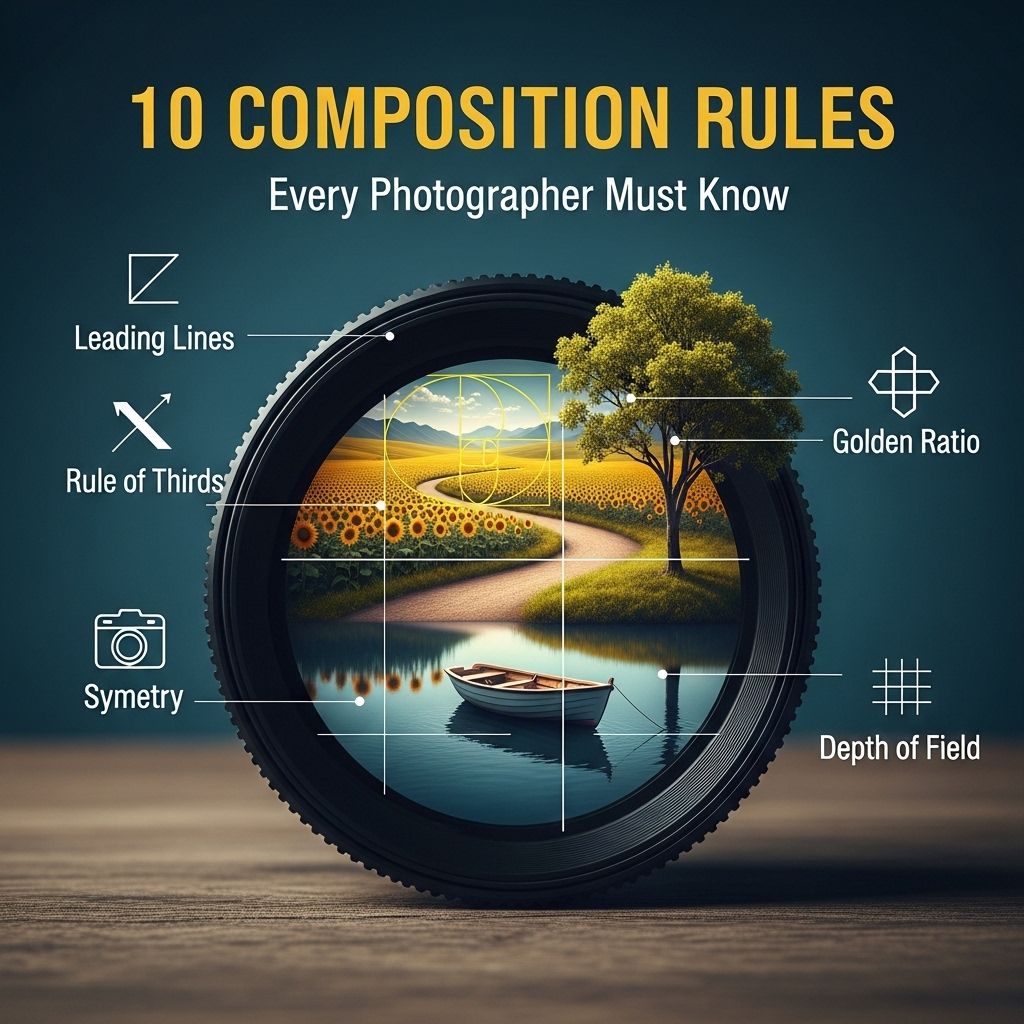
Photography is not just about pointing a camera and clicking a button; it’s an art form that relies heavily on composition. Good composition can shift an ordinary photo into a captivating image that tells a story or evokes emotions. Understanding and using composition rules can take your photography to the next level. Here are ten essential rules every photographer must know, along with practical applications and examples.
Composition is the backbone of effective photography, guiding how elements within a frame interact to create compelling images. Whether you’re a beginner or an experienced photographer, mastering these 10 essential composition rules can elevate your work significantly. For added inspiration, you might find the best 3D logo templates helpful in visualizing design principles.
The Rule of Thirds
The rule of thirds is one of the most fundamental and widely recognized rules in photography. It involves dividing the image into a 3×3 grid, creating nine equal parts. The key elements of the composition should be placed along these lines or their intersections.
How to Implement the Rule of Thirds
- Enable the grid feature on your camera or phone.
- Position points of interest at the intersections.
- Experiment with breaking the rule for creative effects.
Leading lines are natural lines within a scene that lead the viewer’s eye toward the subject. These can be roads, paths, fences, or any other line that creates a visual guide.
Examples of Leading Lines
- Roads or highways leading into the horizon.
- Railways stretching into the distance.
- A river curving through the landscape.
Framing
Framing involves using elements within the scene to create a ‘frame’ around the main subject. This technique draws attention to the subject and adds depth to the photo.
Effective Framing Techniques
| Element | Example |
|---|---|
| Trees | Using branches to create a natural frame. |
| Windows | Capturing a subject through an open window. |
| Archways | Positioning the subject within the confines of an arch. |
Symmetry and Patterns
Symmetry is visually pleasing and can create striking compositions. Patterns, whether natural or man-made, can also add interest to a photograph.
Finding Symmetry and Patterns
- Look for reflections in water or glass.
- Capture architectural elements that showcase symmetry.
- Identify repeating designs in nature or urban environments.
Depth and Layers
Creating depth in your images can make them more engaging. Layering different elements in the foreground, mid-ground, and background can add dimension to a flat photograph.
Techniques to Create Depth
- Incorporate foreground elements to lead into the photo.
- Use a wide aperture to blur the background, focusing on the subject.
- Include layers of interest, like clouds, mountains, and trees.
Balancing Elements
When composing an image, it’s essential to balance the various elements within the frame. An unbalanced composition may feel awkward and distract from the subject.
How to Achieve Balance
- Distribute visual weight evenly across the frame.
- Use color, size, and placement to balance elements.
- Combine busy areas with simpler backgrounds.
Color Theory
Understanding color theory can significantly enhance your photography. Colors can evoke emotions and create mood. Utilizing complementary colors or monochromatic schemes can affect the visual impact of your images.
Applying Color Theory
| Color Scheme | Description |
|---|---|
| Complementary | Colors opposite each other on the color wheel. |
| Analogous | Colors next to each other on the color wheel. |
| Monochromatic | Variations of a single color. |
Negative Space
Negative space refers to the area around your subject. Utilizing negative space can make your subject stand out, providing context and focus.
Using Negative Space Effectively
- Leave ample space around the subject to emphasize it.
- Consider minimalist compositions to highlight your subject.
- Experiment with various backgrounds to find the right contrast.
Experimentation and Rule Breaking
While the rules of composition are essential, it’s equally important to understand when to break them. Creative photography often comes from experimentation and pushing boundaries.
When to Break the Rules
- If it serves your creative vision.
- To create surprise or intrigue.
- When trying to convey a specific emotion or message.
Conclusion
Mastering composition rules can transform your photography, enabling you to create images that resonate with viewers. Remember, while these rules provide a framework, the most important aspect is your unique perspective and creativity. Get out there, practice these techniques, and develop your own style as a photographer!
FAQ
What are the basic composition rules in photography?
The basic composition rules include the Rule of Thirds, Leading Lines, Framing, Symmetry, Depth, and the Golden Ratio.
How does the Rule of Thirds improve photography composition?
The Rule of Thirds suggests dividing your image into nine equal segments by two vertical and two horizontal lines, placing points of interest along these lines or at their intersections to create a more balanced and engaging photograph.
What is the importance of leading lines in photography?
Leading lines direct the viewer’s eye towards the subject of the photo, creating depth and a sense of perspective, which can enhance the overall composition.
How can I use framing to enhance my photos?
Framing involves using elements within the scene to create a ‘frame’ around your subject, which helps draw attention to it and adds a sense of context to your image.
What role does symmetry play in photography composition?
Symmetry can create a sense of harmony and balance in your images, making them aesthetically pleasing; however, asymmetrical compositions can also be striking when used effectively.
Why is understanding depth important in photography?
Understanding depth allows photographers to create a sense of three-dimensionality in their images, making them more immersive and engaging by using foreground, middle ground, and background elements.