10 Composition Rules to Elevate Your Photography
Discover 10 essential composition rules that will transform your photography skills and enhance your visual storytelling.

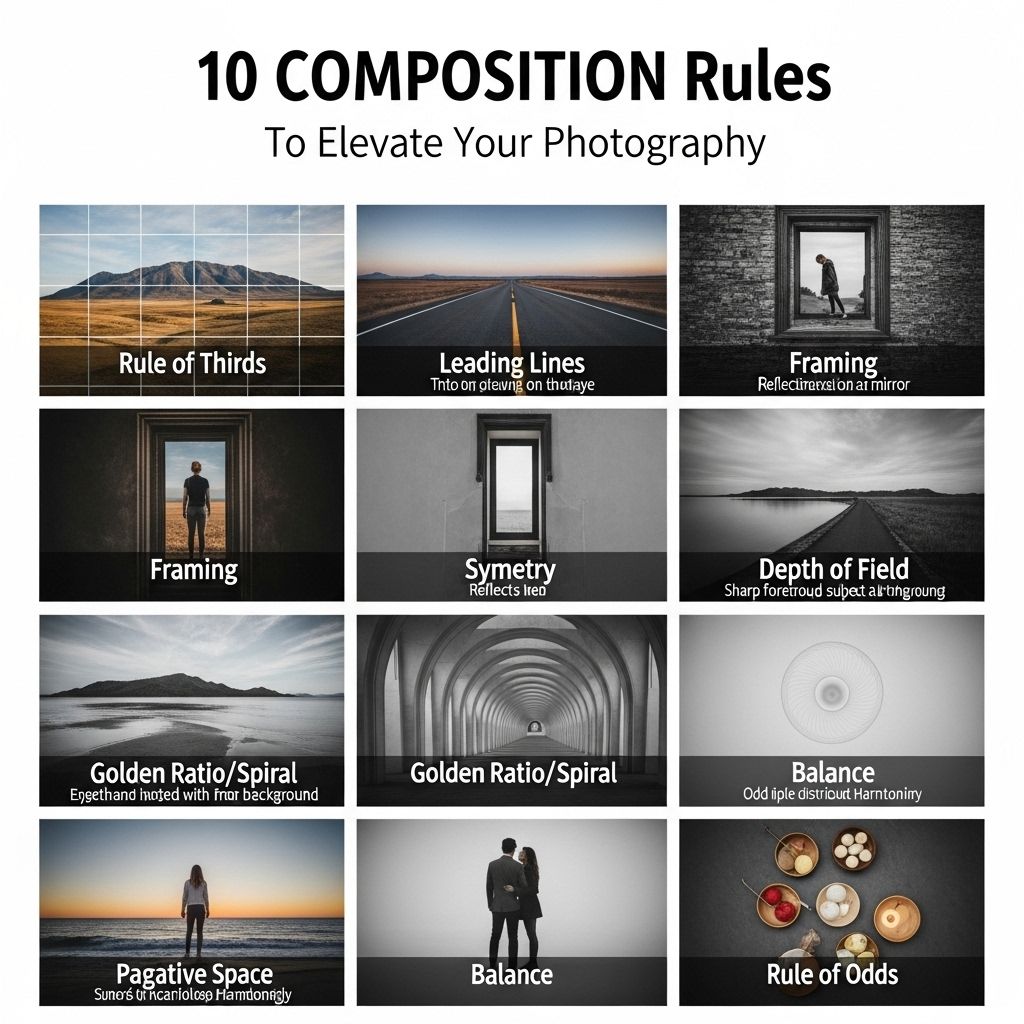
Photography is an art form that transcends mere technical skill. It is a blend of creativity, emotion, and technique. The ability to capture a moment in time, convey mood, and tell a story through images is what defines great photography. However, even skilled photographers can struggle with composition. Understanding the rules of composition can elevate your photographs into captivating pieces of art. Here, we will explore ten essential composition rules that can enhance your photography skills and help you create visually striking images.
Composition plays a crucial role in photography, transforming ordinary images into captivating visual stories. Understanding and applying various composition rules can significantly elevate your photography skills, allowing you to create more dynamic and engaging images. For those looking to enhance their creative presentations, check out our 3D mockup collection.
Table of Contents
1. The Rule of Thirds
One of the most fundamental concepts in photography is the Rule of Thirds. This principle suggests dividing your image into nine equal parts by two vertical and two horizontal lines. You should position the most important elements of your scene along these lines or at their intersections. This technique creates a more balanced and interesting composition.
How to Apply It:
- Enable the grid feature on your camera or editing software.
- Place key elements along the grid lines or at the intersection points to draw the viewer’s eye.
- Consider leading lines that might intersect with these points to enhance depth.
2. Leading Lines
Leading lines are elements in your photograph that guide the viewer’s eye towards the main subject. These can be roads, paths, rivers, or even shadows. Utilizing leading lines can create a sense of depth and perspective in your images, making them feel more dynamic and engaging.
Examples of Leading Lines:
- Roads or pathways
- Fences or railings
- Rivers or streams
- Architectural elements
3. Framing
Framing involves using elements within the scene to create a ‘frame’ around your subject. This technique helps to isolate the main subject and draw the viewer’s attention directly to it. Natural elements like trees, archways, or windows can serve as frames.
Techniques for Effective Framing:
- Look for natural frames in your environment.
- Consider the shape and size of your frame to emphasize your subject.
- Experiment with different angles to find the best framing composition.
4. Symmetry and Patterns
Symmetry provides a sense of balance and order in an image, while patterns can add visual interest. Both can be used effectively in composition to create striking images. Symmetrical compositions are often more appealing to the eye and can evoke feelings of harmony.
Ways to Incorporate Symmetry:
- Look for naturally symmetrical subjects, such as buildings or landscapes.
- Use reflections in water for symmetrical compositions.
- Experiment with cropping to enhance symmetry.
5. Depth of Field
Depth of field refers to the range of distance within a photo that appears sharp. A shallow depth of field can isolate your subject from the background, while a deeper depth of field can keep more of the scene in focus. Choosing the right depth of field can significantly impact the composition.
Depth of Field Tips:
- Use a wide aperture (small f-number) for a shallow depth of field.
- Utilize a narrow aperture (larger f-number) to achieve greater depth of field.
- Experiment with both to see which works best for your subject and scene.
6. Negative Space
Negative space is the area surrounding your main subject. Using negative space effectively can create a sense of minimalism and can enhance the focus on the subject. It can also evoke emotions and create a mood within your photograph.
Using Negative Space:
- Position your subject off-center to allow for negative space.
- Choose backgrounds that enhance the feelings you want to convey.
- Experiment with different compositions that emphasize negative space.
7. Color Theory
Understanding color theory can significantly improve your composition. Different colors can evoke different emotions and can be used to enhance the narrative of your photograph. Complementary colors can create contrast and draw attention, while analogous colors can create harmony.
Using Color in Photography:
- Experiment with color contrasts to emphasize your subject.
- Use color palettes that evoke specific emotions.
- Consider the color of the light during different times of the day (golden hour, blue hour, etc.).
8. The Golden Ratio
The Golden Ratio is a mathematical ratio that is often found in nature and can create aesthetically pleasing compositions. Utilizing the Golden Spiral can help you position elements in a way that leads the viewer’s eye through the image.
Applying the Golden Ratio:
- Use the spiral as a guide to place subjects in your frame.
- Experiment with the ratio in cropping and editing.
- Look for natural occurrences of the Golden Ratio in the environment.
9. Balance and Weight
For a composition to feel stable, it should have a sense of balance. This doesn’t mean that everything has to be symmetrical; rather, different elements can balance each other out in terms of visual weight. Recognizing the weight of various elements can result in more compelling compositions.
Achieving Balance:
- Consider the size and color of elements in your frame.
- Distribute various elements evenly throughout the image.
- Experiment with placement to find visual balance.
10. Break the Rules
While these composition rules provide valuable guidelines, the most important aspect of photography is creativity. Don’t be afraid to break these rules to express your unique vision. Many iconic photographs have emerged from breaking the conventional rules of composition.
Embracing Creativity:
- Experiment liberally with angles, perspectives, and techniques.
- Trust your instincts and vision for the shot.
- Review your work and learn from what resonates with you.
In conclusion, mastering composition is crucial for any photographer wanting to elevate their work. By understanding and applying these ten rules, you can create compelling, memorable photographs. Remember to practice regularly, analyze your compositions, and most importantly, have fun exploring the world through your lens.
FAQ
What are the basic composition rules in photography?
Basic composition rules include the Rule of Thirds, leading lines, framing, symmetry, and the use of negative space to enhance your images.
How does the Rule of Thirds improve photo composition?
The Rule of Thirds suggests dividing your image into a 3×3 grid and placing key elements along these lines or at their intersections, creating more balanced and engaging photographs.
What are leading lines and how do they affect composition?
Leading lines are natural lines within the scene that guide the viewer’s eye toward the main subject, enhancing depth and perspective in your photography.
Why is framing important in photography composition?
Framing involves using elements within the scene to create a ‘frame’ around the subject, drawing attention and adding depth, making the photo more compelling.
How can I use symmetry to create striking photographs?
Using symmetry involves balancing elements on either side of the image, which can create a sense of harmony and beauty, making your photograph visually appealing.
What is negative space and how does it enhance photography?
Negative space refers to the empty areas surrounding your subject; it helps to highlight the main subject and can create a more minimalist and impactful image.