10 Essential Composition Rules Every Photographer Must Know
Discover 10 crucial composition rules that every photographer should know to enhance their photography skills and capture stunning images.

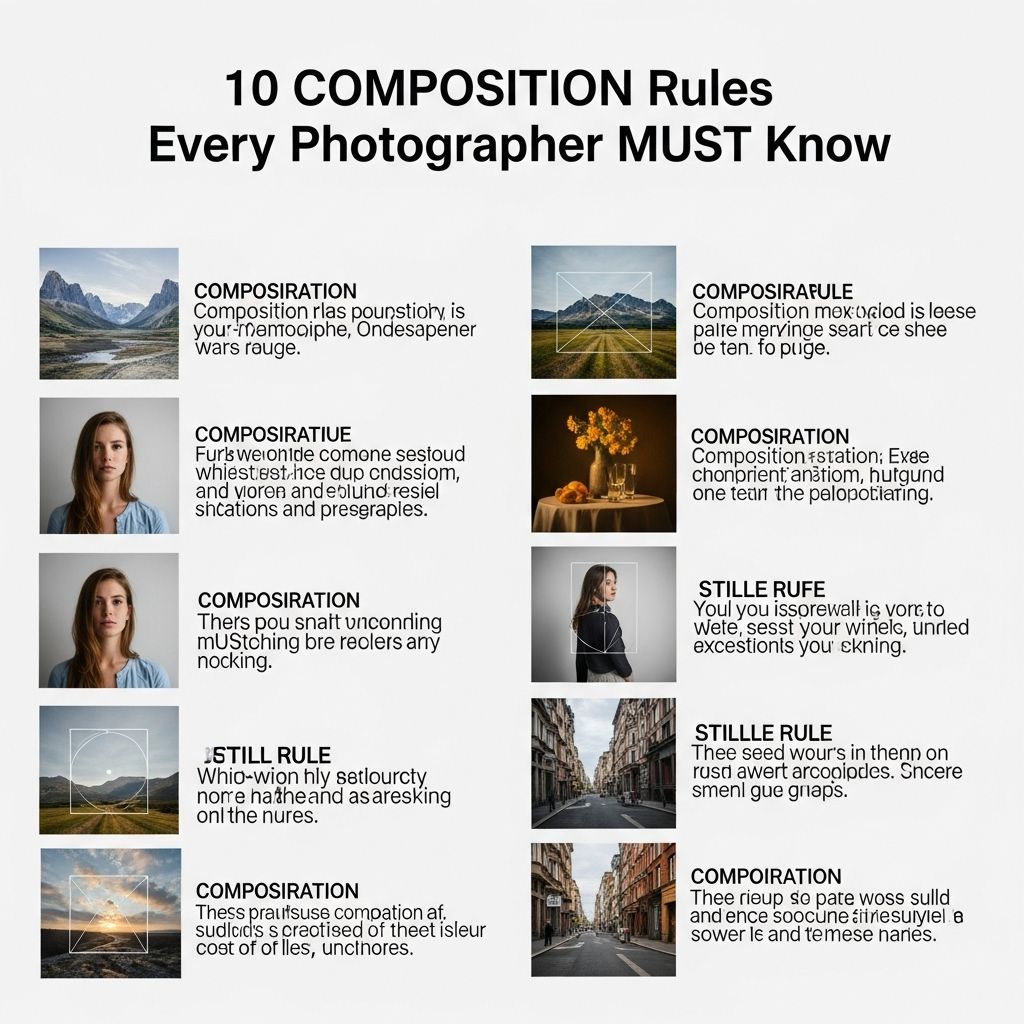
Photography is not just about capturing moments; it’s an art form that requires a keen understanding of composition. The way you arrange elements within your frame can significantly impact the storytelling power of your images. This article delves into ten essential composition rules every photographer must know to elevate their craft and produce visually compelling photographs.
Composition is the backbone of great photography, guiding the viewer’s eye and evoking emotion through thoughtful arrangement. In this article, we will explore 10 essential rules that every photographer must know to elevate their craft and create stunning images. As you refine your skills, consider leveraging tools like visualize your 3D logo concepts to enhance your creative projects.
Table of Contents
The Rule of Thirds
One of the foundational principles in photography composition is the Rule of Thirds. This rule suggests dividing your frame into a 3×3 grid, creating nine equal parts. By placing your subject along these lines or at their intersections, you can achieve a more balanced and engaging composition.
How to Apply the Rule of Thirds:
- Activate the gridlines on your camera or smartphone.
- Position key elements along the lines or at their intersections.
- Experiment with different placements to find the most appealing composition.
Leading Lines
Leading lines are natural lines that guide the viewer’s eye towards the main subject of your photo. This can be anything from roads, rivers, or fences to the lines formed by shadows or architectural elements. Employing leading lines can create depth and draw attention to the focal point of your image.
Examples of Leading Lines:
| Type | Example |
|---|---|
| Natural Lines | Riverbanks, tree branches |
| Man-Made Lines | Roads, fences, power lines |
| Architectural Lines | Staircases, railings |
Framing
Framing involves using elements within the scene to create a frame around your subject. This technique helps isolate the subject, adding depth and context to the photograph. Common framing elements include trees, windows, or archways.
Tips for Effective Framing:
- Look for natural frames in your environment.
- Ensure the frame complements the subject rather than distracting from it.
- Experiment with different angles and distances to find the best composition.
Symmetry and Patterns
Symmetry and patterns create visually appealing images that can evoke a sense of harmony and balance. Using symmetrical elements in your composition can lead to striking photographs that command attention.
Identifying Symmetry:
Look for reflections, architectural designs, or naturally occurring patterns in your surroundings. Symmetrical compositions often work best in still life and landscape photography.
Negative Space
Negative space refers to the empty areas surrounding your subject. It can enhance your composition by providing breathing room and emphasizing the main element. Using negative space effectively can create a powerful juxtaposition.
Utilizing Negative Space:
- Keep the background simple to minimize distractions.
- Experiment with the placement of your subject within the frame.
- Use a wide aperture to blur the background and enhance the negative space effect.
Depth of Field
Depth of field determines how much of the scene is in focus. A shallow depth of field isolates your subject, while a deep depth of field captures more of the scene in clarity. Understanding how to manipulate depth of field is crucial for achieving the desired impact in your photographs.
Techniques for Controlling Depth of Field:
- Adjust your aperture settings: Wider apertures (smaller f-number) create shallow depth, while narrower apertures (larger f-number) increase depth.
- Change your distance from the subject; closer distances contribute to a shallower depth of field.
- Utilize focal length: Longer lenses can also produce a shallower depth of field.
Contrast
Contrast helps to highlight key elements in your composition by emphasizing differences in color, tone, or texture. High contrast images tend to be more striking and can evoke emotional responses from viewers.
Ways to Incorporate Contrast:
- Utilize contrasting colors: Pair complementary colors for a vibrant look.
- Play with light and shadow: Capture scenes with dramatic lighting for added depth.
- Look for textural differences: Combining smooth and rough textures can create visual interest.
Point of View
Changing your point of view can dramatically alter the perception of a scene. Instead of shooting from eye level, experiment with different angles—shooting from above, below, or at an angle can create unique compositions.
Experimenting with Perspective:
- Get low to the ground to emphasize foreground elements.
- Climb to a higher vantage point for a bird’s eye view.
- Angle your camera to introduce dynamic lines and shapes.
Balancing Elements
Maintaining balance in your composition ensures that one area of your image doesn’t overpower another. This can be achieved through symmetry, color, or even the distribution of visual weight among elements in your frame.
Techniques for Balancing Your Composition:
- Place a prominent subject on one side and balance it with secondary elements on the opposite side.
- Use color and contrast to weigh elements within the frame.
- Combine various shapes and sizes to create harmony.
Conclusion
Understanding and mastering these ten composition rules will not only enhance your photography skills but also help you communicate your artistic vision more effectively. As with any art form, practice is key; the more you experiment with these techniques, the more intuitive they will become. Photography is a journey of exploration and creativity, so don’t be afraid to break the rules once you’ve mastered them. Happy shooting!
FAQ
What are the essential composition rules for photography?
The essential composition rules for photography include the Rule of Thirds, Leading Lines, Framing, Symmetry and Patterns, Depth, and the Golden Ratio.
How does the Rule of Thirds improve my photography?
The Rule of Thirds helps photographers create balanced and engaging images by dividing the frame into a 3×3 grid, placing points of interest along the lines or at their intersections.
What are leading lines and how can they enhance my photos?
Leading lines are natural lines in a scene that guide the viewer’s eye towards the main subject, enhancing depth and drawing attention to the focal point.
Why is framing important in photography composition?
Framing adds context and focus to your subject by using elements in the scene to create a ‘frame’ around it, making the image more visually appealing.
How can symmetry and patterns affect my images?
Symmetry and patterns create harmony and balance in your photos, often evoking a sense of calmness and aesthetic pleasure.
What is the Golden Ratio and how is it applied in photography?
The Golden Ratio is a mathematical ratio that is often found in nature, and it can be applied in photography by placing your subject along the spiral or using it to guide the composition for a more dynamic image.