Master Quantum Physics Quickly: A Beginner’s Guide
Discover essential tips and resources to understand quantum physics quickly and easily, even as a beginner. Dive into the fascinating world of quantum mechanics.
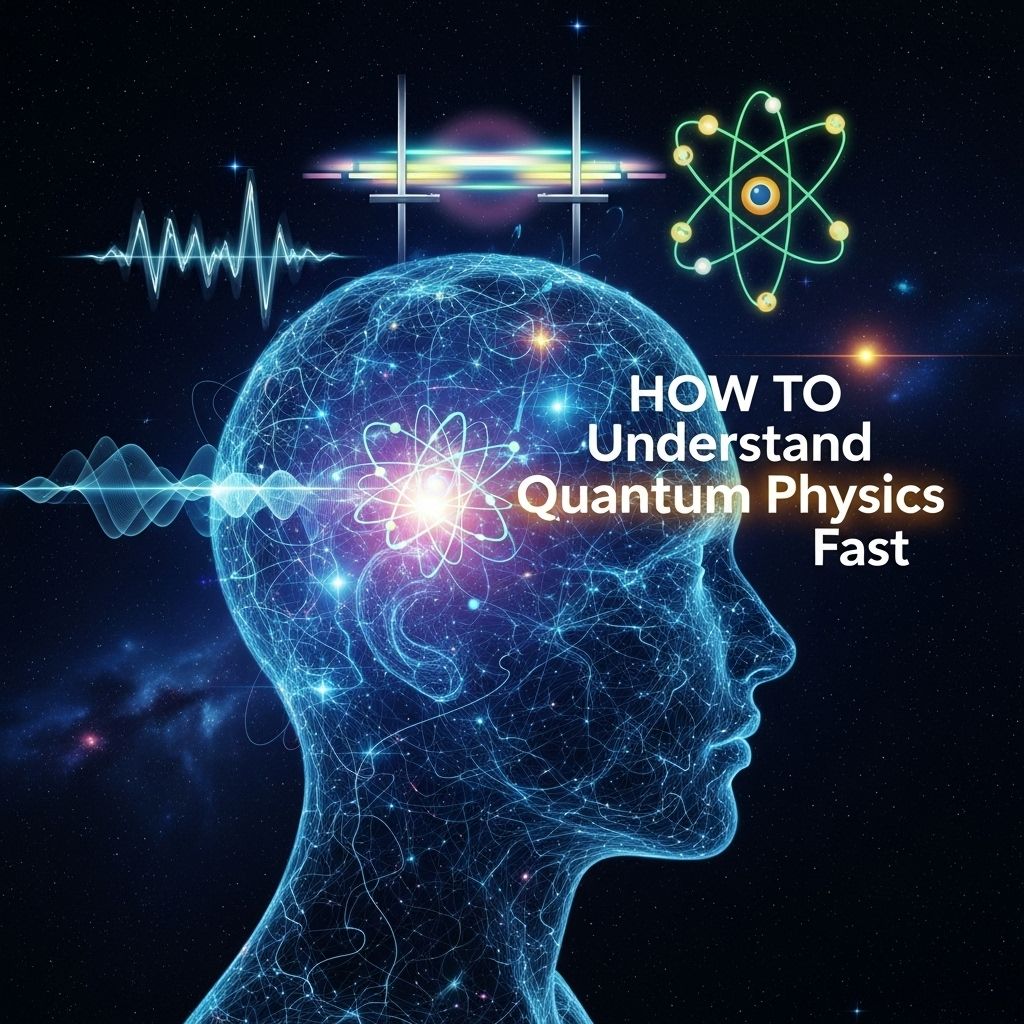
Quantum physics, often seen as a daunting realm of science, is the foundation of modern technology and our understanding of the universe. From quantum computing to quantum cryptography, the principles of quantum mechanics are increasingly relevant in today’s tech-driven world. This article aims to demystify quantum physics and provide a clear path for tech-savvy readers to grasp its core concepts quickly and efficiently.
Quantum physics can seem daunting, but with the right approach, you can master its foundational concepts quickly. This beginner’s guide offers straightforward explanations and practical strategies to demystify the subject. For visual learners, see how to use 3D mockups effectively to enhance your understanding.
The Basics of Quantum Physics
To understand quantum physics, one must first familiarize themselves with its basic principles. Unlike classical physics, quantum mechanics encompasses phenomena that often defy intuitive reasoning. Here are some foundational concepts:
- Wave-Particle Duality: Particles, such as electrons and photons, exhibit both wave-like and particle-like properties.
- Quantum Superposition: A quantum system can exist in multiple states at once until it is measured.
- Quantum Entanglement: Two or more particles can become entangled, meaning the state of one immediately affects the state of another, no matter the distance between them.
- Uncertainty Principle: Formulated by Werner Heisenberg, it states that certain pairs of physical properties, like position and momentum, cannot both be known to arbitrary precision.
Key Historical Figures and Experiments
Understanding the historical context can enhance your grasp of quantum physics. Notable figures and landmark experiments that shaped the field include:
Max Planck and the Quantum Hypothesis
In 1900, Max Planck proposed that energy is quantized, introducing the concept of ‘quanta’ to explain black-body radiation.
Albert Einstein and the Photoelectric Effect
Einstein’s 1905 explanation of the photoelectric effect demonstrated that light can be thought of as particles (photons), contributing to the wave-particle duality concept.
Niels Bohr’s Atomic Model
Bohr’s model suggested that electrons orbit the nucleus in quantized energy levels, which was pivotal for our understanding of atomic structure.
The Double-Slit Experiment
This experiment illustrates wave-particle duality and the impact of observation on quantum systems. When electrons are fired at a double slit, they create an interference pattern, indicating wave-like behavior. However, when observed, they behave like particles.
Core Principles of Quantum Mechanics
Having laid the groundwork, we can now delve into the core principles of quantum mechanics that tech enthusiasts should know.
1. Quantum States
In quantum mechanics, a system is fully described by its quantum state, often represented as a wave function. The wave function encapsulates all the possible information about a system.
2. Measurement and Collapse
Upon measurement, a quantum system ‘collapses’ into a definite state from its superposition. The outcome of a measurement is probabilistic, governed by the square of the wave function’s amplitude.
3. Quantum Tunneling
This phenomenon allows particles to pass through potential energy barriers, defying classical physics. It’s a crucial mechanism in nuclear fusion and the functioning of semiconductor devices.
Applications of Quantum Physics
Quantum mechanics is not merely a theoretical framework; it has numerous practical applications that impact everyday technology:
1. Quantum Computing
Quantum computers leverage quantum superposition and entanglement to perform calculations at unprecedented speeds. Unlike classical bits, which represent a 0 or 1, quantum bits (qubits) can represent multiple states simultaneously.
2. Quantum Cryptography
Using principles of quantum mechanics, quantum cryptography offers secure communication methods that are theoretically immune to eavesdropping, ensuring that any attempt to intercept data alters the transmission.
3. Quantum Sensors
These sensors utilize quantum properties to measure physical quantities with extreme precision, relevant in fields ranging from navigation to medical imaging.
How to Learn Quantum Physics Quickly
If you’re eager to understand quantum physics without getting lost in complex mathematics, consider the following steps:
1. Start with Online Courses
Platforms like Coursera, edX, and Khan Academy offer introductory courses in quantum physics tailored for beginners.
2. Use Visual Aids
Diagrams, animations, and videos can make abstract concepts more tangible. Websites like YouTube have a wealth of educational content.
3. Read Popular Science Books
Books like ‘Quantum Physics for Beginners’ or ‘The Quantum World’ simplify complex ideas into digestible formats.
4. Join Online Communities
Engaging with forums like Reddit’s r/QuantumPhysics or Stack Exchange can offer insights and motivation.
5. Practice Problem-Solving
Work on simple quantum mechanics problems and scenarios to reinforce your understanding. Websites like Physics Classroom provide exercises.
Common Misconceptions
As you delve into quantum physics, be aware of common misconceptions:
| Misconception | Reality |
|---|---|
| Quantum mechanics is only for physicists. | Quantum principles apply to technologies we use daily, such as lasers and semiconductors. |
| Observations don’t affect quantum systems. | The act of measurement fundamentally alters a quantum system’s state. |
| Quantum physics is purely theoretical. | Many quantum principles are experimentally verified and are critical in technology development. |
Conclusion
Quantum physics, while complex, is an accessible field of study with profound implications for technology and our understanding of the universe. By grasping its fundamental principles and engaging with the material through various resources, tech-savvy individuals can demystify this fascinating area of science. Whether your goal is to explore quantum computing, cryptography, or simply gain a better understanding of the universe, the journey into quantum physics is sure to be enlightening.
FAQ
What are the basics of quantum physics?
Quantum physics studies the behavior of matter and energy at the smallest scales, focusing on phenomena like wave-particle duality, superposition, and entanglement.
What are some effective ways to learn quantum physics quickly?
To learn quantum physics quickly, consider online courses, video lectures, and textbooks that simplify complex concepts. Engage in problem-solving and discussions with peers or online forums.
Are there any recommended resources for beginners in quantum physics?
Yes, resources like ‘Quantum Physics for Beginners’ by Carl J. Pratt and YouTube channels like ‘PBS Space Time’ provide accessible introductions to quantum concepts.
How does quantum physics differ from classical physics?
Quantum physics differs from classical physics in that it describes phenomena at atomic and subatomic levels, where particles exhibit behaviors like superposition and entanglement that classical physics cannot explain.
What is wave-particle duality in quantum physics?
Wave-particle duality is the concept that particles, such as electrons and photons, can exhibit both wave-like and particle-like properties depending on how they are observed.
Why is quantum physics important in today’s technology?
Quantum physics is crucial for the development of modern technologies such as semiconductors, lasers, quantum computing, and medical imaging techniques like MRI.