
10 Essential Poetry Devices You Must Know
Discover 10 powerful poetry devices that can elevate your writing and deepen your understanding of poetic forms and techniques.
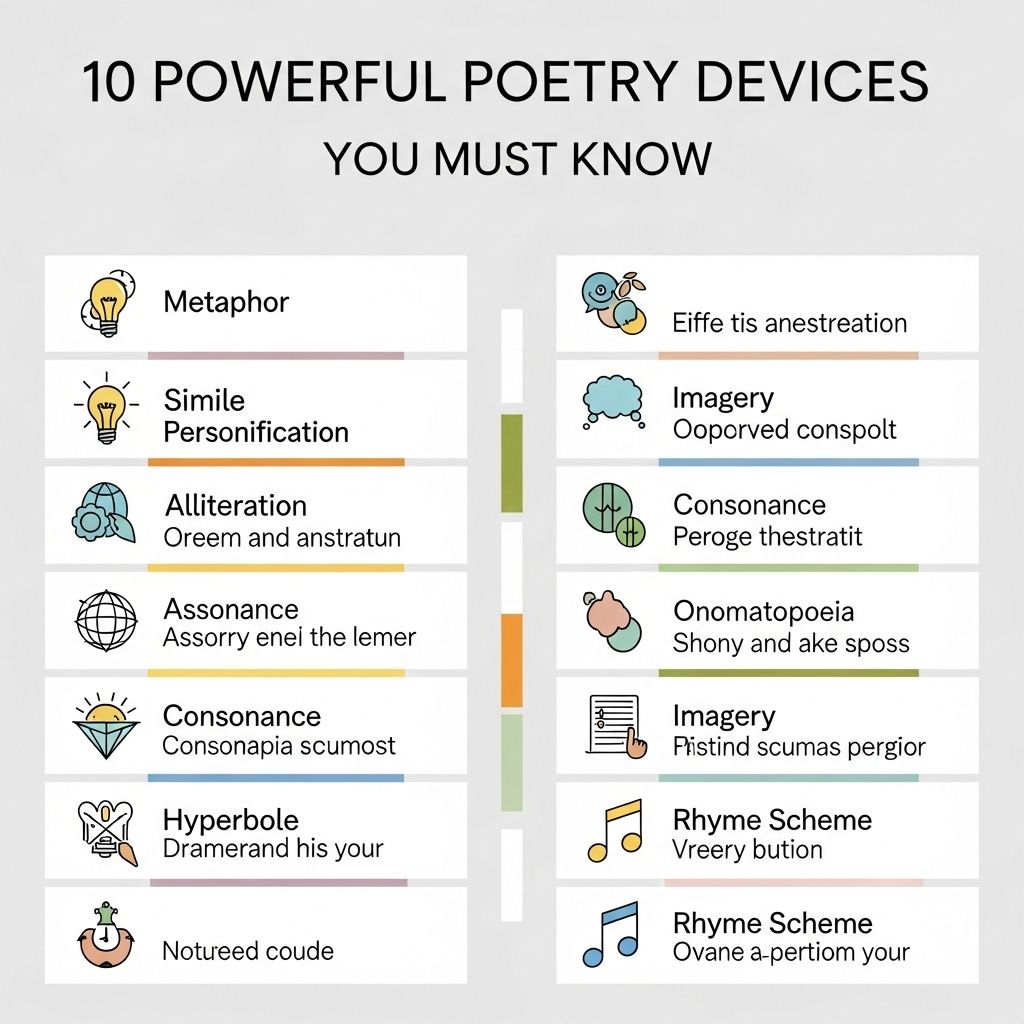
Poetry is a unique form of expression that transcends the boundaries of ordinary language. It allows poets to explore complex emotions and ideas in a condensed format, often using various devices to enhance meaning and evoke feelings. Understanding these devices is essential for both analyzing poetry and crafting your own. In this article, we will uncover ten powerful poetry devices that every poet and poetry enthusiast should be familiar with.
Poetry, an art form rich with emotion and meaning, employs various devices that enhance its beauty and resonance. Understanding these essential devices, from metaphor to alliteration, can elevate both writing and appreciation of poetry. For a creative twist in presentation, check out our 3D mockup collection.
1. Metaphor
A metaphor is a figure of speech that makes a comparison between two unlike things by stating that one is the other. This device allows poets to convey deeper meanings through vivid imagery.
Example:
“Time is a thief that steals our moments.”
2. Simile
Similar to a metaphor, a simile makes a comparison between two different things but uses the words ‘like’ or ‘as’ to draw the connection. This can make imagery more relatable and vivid.
Example:
“Her smile was like sunshine, warming the coldest of hearts.”
3. Alliteration
Alliteration involves the repetition of the same consonant sounds at the beginning of closely placed words. It creates rhythm and can enhance the musicality of a poem.
Example:
“Peter Piper picked a peck of pickled peppers.”
4. Personification
This device gives human characteristics to non-human entities, allowing readers to relate emotionally to inanimate objects or abstract concepts.
Example:
“The wind whispered through the trees, carrying secrets of the night.”
5. Hyperbole
Hyperbole is an exaggerated statement not meant to be taken literally. It emphasizes a feeling or a fact by overstating it, often used for dramatic effect.
Example:
“I’ve told you a million times to clean your room!”
6. Imagery
Imagery involves the use of descriptive language that appeals to the senses, helping readers visualize scenes and feel emotions. Effective imagery is crucial for immersing readers in a poem’s world.
Types of Imagery:
- Sensory Imagery: Appeals to taste, touch, sight, hearing, and smell.
- Visual Imagery: Focuses on sight and visual elements.
- Auditory Imagery: Relates to sounds.
- Olfactory Imagery: Involves smells.
7. Rhyme Scheme
The rhyme scheme refers to the pattern of rhymes at the end of each line of a poem. It can influence the poem’s rhythm and thematic structure.
Common Rhyme Schemes:
- ABAB: Alternating lines rhyme.
- AABB: Consecutive lines rhyme.
- ABBA: Enclosed rhyme.
8. Assonance
Assonance is the repetition of vowel sounds within closely placed words. This device can create internal rhyming and contribute to the musical quality of a poem.
Example:
“The rain in Spain falls mainly in the plain.”
9. Enjambment
Enjambment occurs when a line of poetry continues into the next line without a pause or break. This technique can create a sense of urgency or fluidity within a poem.
Example:
“I wandered lonely as a cloud
That floats on high o’er vales and hills,”
10. Symbolism
Symbolism involves using symbols to represent larger concepts or ideas, allowing poets to convey complex themes through simple images or objects.
Example:
“A dove often symbolizes peace.”
Conclusion
Mastering these poetry devices can elevate your writing and deepen your appreciation for the craft. Whether you’re reading or writing poetry, recognizing and employing these techniques will enrich your understanding and enjoyment of this art form. So, the next time you pick up a poem or sit down to write one, consider how these powerful tools can enhance your expression.
FAQ
What are the most important poetry devices to understand?
Some of the most important poetry devices include metaphor, simile, alliteration, imagery, personification, and rhyme.
How does metaphor enhance a poem?
Metaphor enhances a poem by making comparisons that create deeper meanings and evoke emotions in the reader.
What is the role of imagery in poetry?
Imagery plays a crucial role in poetry as it helps to create vivid pictures in the reader’s mind, appealing to the senses and enhancing the overall experience.
Can you explain what alliteration is?
Alliteration is the repetition of initial consonant sounds in a series of words, which can create rhythm and musicality in poetry.
What is personification and how is it used in poetry?
Personification is a literary device where human traits are attributed to non-human objects or abstract concepts, making them relatable and engaging for readers.
Why is rhyme important in poetry?
Rhyme is important in poetry as it adds a musical quality, enhances the flow, and can reinforce the themes or emotions being conveyed.